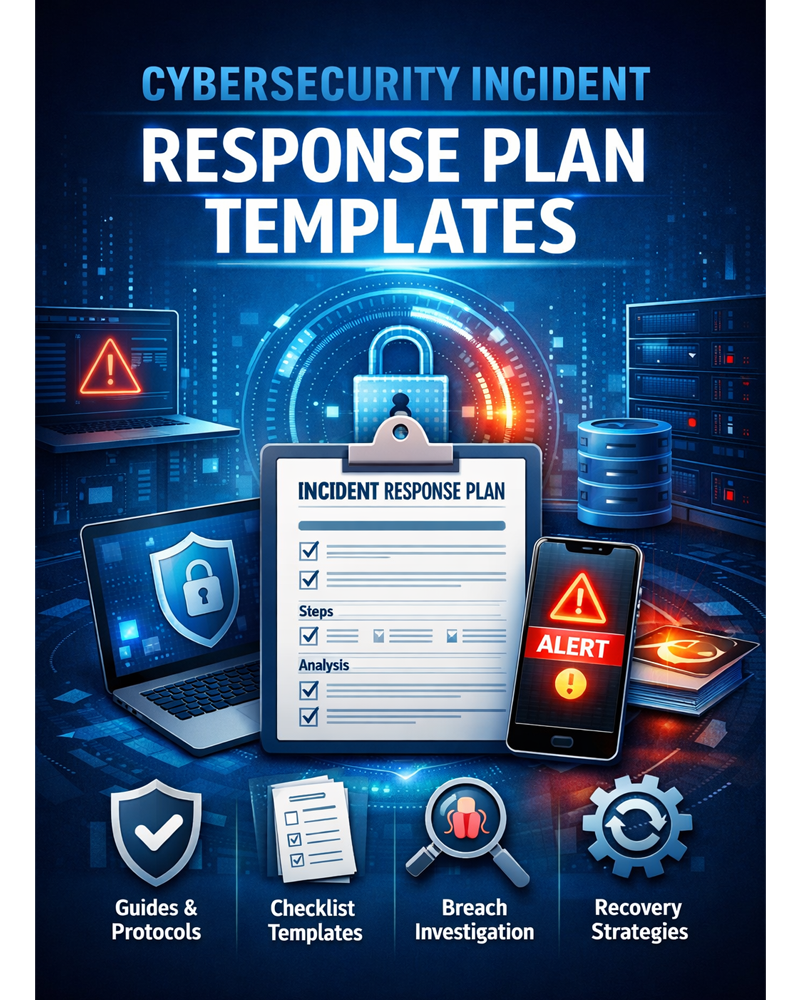


Download ready-to-use Cybersecurity Incident Response Plan templates to prepare for data breaches, ransomware, phishing, and insider threats. Our incident response plan (IRP) templates include NIST-aligned phases: preparation, detection and analysis, containment, eradication, recovery, and post-incident review. Each template provides clear roles and responsibilities, escalation paths, evidence handling, and a communication plan for executives, IT, legal, and customers. Use customizable checklists and playbooks to reduce downtime, meet compliance requirements, and improve security resilience. Includes severity matrix, reporting templates, and guidance for tabletop exercises, SOC workflows, and ticketing systems. Start faster, respond smarter, and document every step for audits and continuous improvement.
Total 75 documents in this Suite
Templates in the Suite (12 Core Templates):
- Step-by-step Guide for How to Use the Templates
- Cyber Security Incident Response Management Plan (CSIRMP)
- Cyber Security Incident Response Plan (CSIRP)
- Cyber Security Incident Response Management Procedure
- Cyber Security Incident Response Plan Checklist
- Cyber Security Incident Response Preparation Checklist
- Cyber Security Vulnerability Response Checklist
- CSIRT Meeting Agenda
- CSIRT Meeting Notes
- Initial Internal Management Security Incident Alert
- CSIRT Issues and Goals List
- CSIRT Action Tracking List
- CSIRT Member Activity Tracking Log
21 Scenarios Templates, Completed Examples and One Page Checklist (21 scenarios x 3 documents per scenario: total 63 documents)
- Compromised Database Server
- Worm Distributed Denial of Service (DDoS) Agent Infestation
- Stolen Documents
- Domain Name System (DNS) Server Denial of Service (DoS)
- Unknown Exfiltration
- Unauthorized Access to Payroll Records
- Disappearing Host
- Telecommuting Compromise
- Anonymous Threat
- Peer-to-Peer File Sharing
- Unknown Wireless Access Point
- Ransomware with Data Theft (Double Extortion)
- Business Email Compromise (BEC) / Fraudulent Payment
- Cloud Storage Misconfiguration (Public Bucket/Container Exposure)
- Third-Party / Vendor Compromise (SaaS Provider / MSP Compromise)
- Insider Data Theft
- Credential Stuffing / Account Takeover
- Web Application Vulnerability Exploitation
- Compromised Privileged Identity / IAM Misconfiguration (Cloud Role Abuse)
- Cryptomining / Resource Hijacking (Cloud Spend Spike)
- Lost/Stolen Endpoint with Sensitive Data (Laptop/Mobile)
ISO Compliance Checklist for Supremus (NIST-Based) Templates
| NIST 800-61 Rev. 3 Function | ISO 27035 Stage | ISO 27001:2022 Control (Annex A) | Relevant Supremus Document Types |
| GOVERN (GV) | Plan & Prepare | A.5.1 (Policies), A.5.2 (Roles) | IR Policy, IR Plan, CSIRT Team Roles, Management Commitment Statement |
| IDENTIFY (ID) | Plan & Prepare | A.5.9 (Inventory), A.5.36 (Compliance) | Asset Inventory, Criticality Matrix, Regulatory Contact List (HIPAA/GDPR) |
| PROTECT (PR) | Plan & Prepare | A.7.22 (Awareness), A.8.9 (Config) | Staff Training Logs, System Hardening Guides, Access Control Checklists |
| DETECT (DE) | Detection & Reporting | A.8.16 (Monitoring), A.5.24 (Events) | SIEM Alert Triage, Incident Detection Log, Event Categorization Form |
| RESPOND (RS) | Assessment & Response | A.5.26 (Response), A.5.27 (Evidence) | Containment Playbooks, Evidence Chain of Custody, Forensic Collection Logs |
| RECOVER (RC) | Lessons Learned | A.5.28 (Learning), A.8.14 (Backup) | Recovery Checklist, Post-Incident Report (PIR), Business Impact Logs |
Cybersecurity Incident Response Plan Templates is rated 4.7 out of 5 by 211 users.