


Step 1: Choose How You Want to Work
Your training and preparation should match the way you plan to work.
Medical Courier Employee
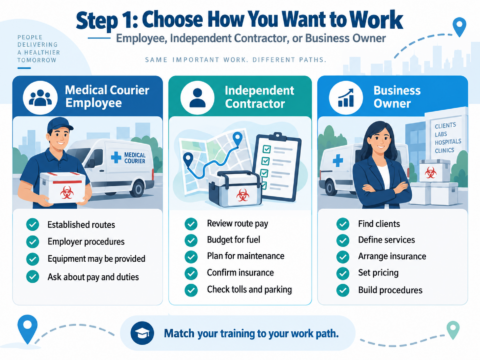
An employee position may provide established routes, procedures, supervision and equipment.-
Before accepting a position, ask about:
- Pay and work schedule
- Vehicle arrangements
- Required training
- Screening requirements
- Equipment provided
- Pickup and delivery duties
You may not need to buy a vehicle or start a business before applying. First confirm what the employer provides and what you must supply.
Independent Medical Courier Contractor
Independent contractors should evaluate both the payment and the cost of completing each route.
Confirm who pays for:
- Fuel
- Vehicle maintenance
- Commercial insurance
- Tolls and parking
- Delivery equipment
- Unpaid waiting time
- Return travel
Worker classification depends on the actual working relationship, not only whether an agreement calls someone an independent contractor.
Medical Courier Business Owner
Business owners must find clients, define services, arrange insurance, set prices and develop operating procedures.
Start with a service area and shipment types that you can manage reliably. Avoid offering specialized transportation or around-the-clock service until you have the training, equipment, insurance and capacity to support it.
Step 2: Confirm the Requirements
Review several medical courier opportunities in your area before buying equipment or selecting training.
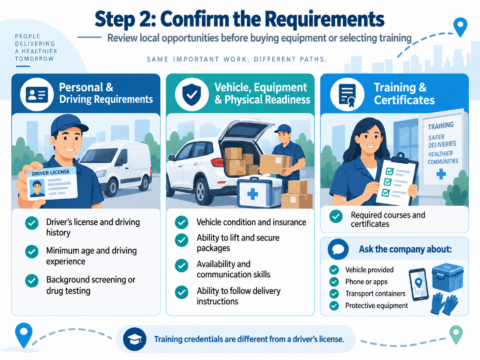
Employers and contracting companies may review:
- Driver’s license and driving history
- Minimum age and driving experience
- Background screening or drug testing
- Vehicle condition and insurance
- Ability to lift and secure packages
- Availability and communication skills
- Required courses and certificates
- Ability to follow delivery instructions
Ask whether the company supplies the vehicle, phone, transport containers, temperature-monitoring equipment or protective equipment.
A medical courier training credential is different from a driver’s license. CDL requirements, USDOT registration, operating authority and state transportation requirements depend on the vehicle and operation. The title “medical courier” does not determine these requirements by itself.
Step 3: Select Your Medical Courier Training Program
We offer three medical courier training paths. You do not need to purchase all three.
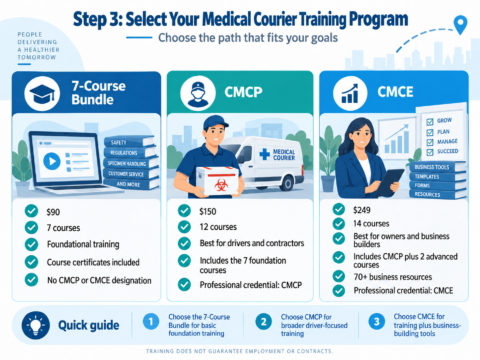
CMCP includes the seven foundation courses plus five additional courses. CMCE includes the complete CMCP curriculum plus two advanced courses.
Step 4: Complete Training and Prepare for Your Duties
Register with the learner’s correct name and email address. Complete the required lessons and assessments, then save the applicable certificates.
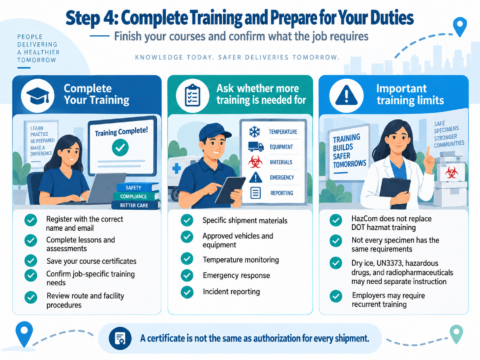
Purchasing CMCP or CMCE does not automatically award the credential. Learners must meet the program’s completion requirements before using the designation.
A course certificate documents completed education. It does not automatically authorize a learner to transport every type of healthcare material.
Before beginning an assignment, ask the employer or client whether additional training is required for:
- Specific shipment materials
- Route and facility procedures
- Approved vehicles and equipment
- Package acceptance
- Temperature monitoring
- Emergency response
- Incident reporting
- Hands-on responsibilities
- Recurrent training
Understand Important Training Limits
- OSHA HazCom training does not replace required DOT hazardous materials training.
- Not every specimen has the same classification or transportation requirements.
- UN3373, dry ice, hazardous drugs and radiopharmaceuticals may require separate instruction.
- Additional highway driver training may be required for certain assigned duties.
- Employers remain responsible for required workplace procedures, testing, records and recurrent training.
The most important question is not simply, “Do I have a certificate?”
Ask:
“Have I received the training and instructions needed for the work I will perform?”
Step 5: Prepare Your Vehicle, Equipment and Documents
Base your purchases on the actual requirements of the job, route or client.
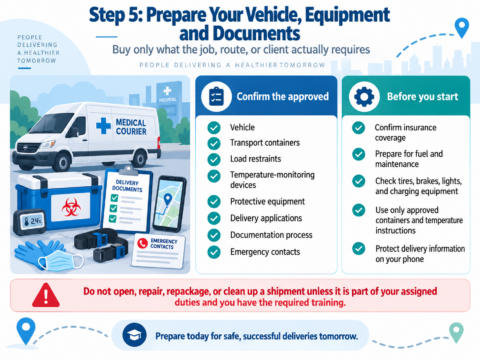
Confirm the approved:
- Vehicle
- Transport containers
- Load restraints
- Temperature-monitoring devices
- Protective equipment
- Delivery applications
- Documentation process
- Emergency contacts
Ask whether you will use a company vehicle or your own vehicle. Confirm insurance coverage before using a personal vehicle for paid delivery work.
Prepare for fuel, maintenance, tires, brakes, lights, charging equipment and vehicle breakdowns.
Use only approved containers and temperature instructions. A household cooler may not be suitable for a temperature-controlled medical shipment.
Protect delivery information stored or accessed on a phone. Use approved applications, secure passwords and screen locks. Follow the required process if a phone is lost or stolen.
Do not open, repair, repackage or clean up a shipment unless the task is part of your assigned duties and you have received the required training.
Step 6: Find Medical Courier Jobs or Clients
Finding Medical Courier Jobs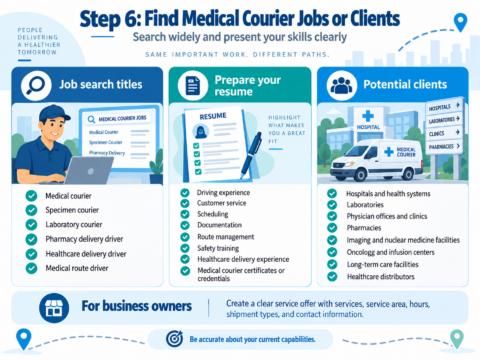
Search using several job titles:
- Medical courier
- Specimen courier
- Laboratory courier
- Pharmacy delivery driver
- Healthcare delivery driver
- Medical route driver
- Medical courier independent contractor
Add your city, state or region to each search.
Prepare a resume that highlights relevant:
- Driving experience
- Customer service
- Scheduling
- Documentation
- Route management
- Safety training
- Healthcare delivery experience
- Medical courier certificates or credentials
Describe your experience accurately. Do not present general delivery work as medical specimen experience unless it involved that type of work.
Read the Step-by-Step Medical Courier Job Guide
Finding Potential Medical Courier Clients
Potential clients and contracting partners may include:
- Hospitals and health systems
- Clinical and diagnostic laboratories
- Physician offices and medical clinics
- Pharmacies and specialty pharmacies
- Imaging and nuclear medicine facilities
- Oncology and infusion centers
- Blood centers and tissue banks
- Long-term care facilities
- Research laboratories
- Healthcare distributors
- Medical courier companies
- Healthcare logistics providers
The client list is a research resource. It does not mean that every organization is hiring, outsourcing deliveries or accepting new vendors.
Step 7: Evaluate the Opportunity Before Starting
Do not accept a position, route or client contract based only on the advertised payment.
For Employment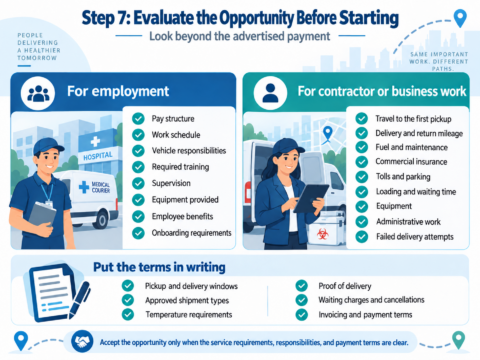
Confirm:
- Pay structure
- Work schedule
- Vehicle responsibilities
- Required training
- Supervision
- Equipment provided
- Employee benefits
- Onboarding requirements
For Contractor or Business Work
Calculate the complete cost of providing the service, including:
- Travel to the first pickup
- Delivery and return mileage
- Fuel and maintenance
- Commercial insurance
- Tolls and parking
- Loading and waiting time
- Equipment
- Administrative work
- Failed delivery attempts
Put the service terms in writing. Address:
- Pickup and delivery windows
- Approved shipment types
- Packaging responsibility
- Temperature requirements
- Proof of delivery
- Waiting charges
- Cancellations
- Incident response
- Invoicing
- Payment terms
A route is worth considering only when the service requirements, responsibilities and payment terms are clear.
Suggested First 30-Day Action Plan
Days 1 to 7: Research and Choose Your Path
Decide whether you want to pursue employment, contractor work or business ownership. Review local opportunities and identify common requirements.
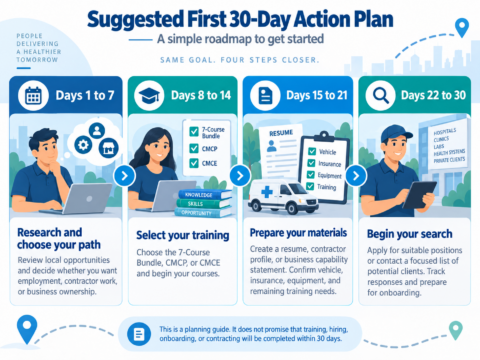
Days 8 to 14: Select Your Training
Choose the seven-course package, CMCP or CMCE based on your goal and expected duties. Begin the courses and organize your training records.
Days 15 to 21: Prepare Your Professional Materials
Create a resume, contractor profile or business capability statement. Confirm your vehicle, insurance, equipment and remaining training needs.
Days 22 to 30: Begin Your Search
Apply for suitable positions or contact a focused list of potential clients. Track responses, prepare for interviews and review onboarding requirements.
This is a planning guide. It does not promise that training, hiring, onboarding or contracting will be completed within 30 days.
Medical Courier Resources
Medical Courier Jobs
Step-by-Step Guide to Finding Medical Courier Jobs in the USA
Business Planning and Client Development
Medical Courier Business Builder Training
Business Templates
Medical Courier Business Resource Pack List and Use Guide
Potential Clients
Comprehensive List of Potential Medical Courier Clients
Training Questions
Medical Courier Training Frequently Asked Questions
Certification and Individual Courses
Visit MedicalCourierCertification.net
Begin Your Medical Courier Training
Choose the training path that matches your career or business goals.
View the Seven-Course Medical Courier Bundle
Become a Certified Medical Courier Professional